



Obrempong Kwabena Osei-Wusu
You Are Not Finished Yet: Nietzsche’s Idea of the Overman
The philosophy of becoming more than the person you are today.
Imagine waking up one day and asking yourself a strange question:
“Am I really becoming the person I am capable of becoming?”
Not whether you are successful. Not whether people like you. Not whether you have achieved what society expects from you.
Just... am I becoming more?
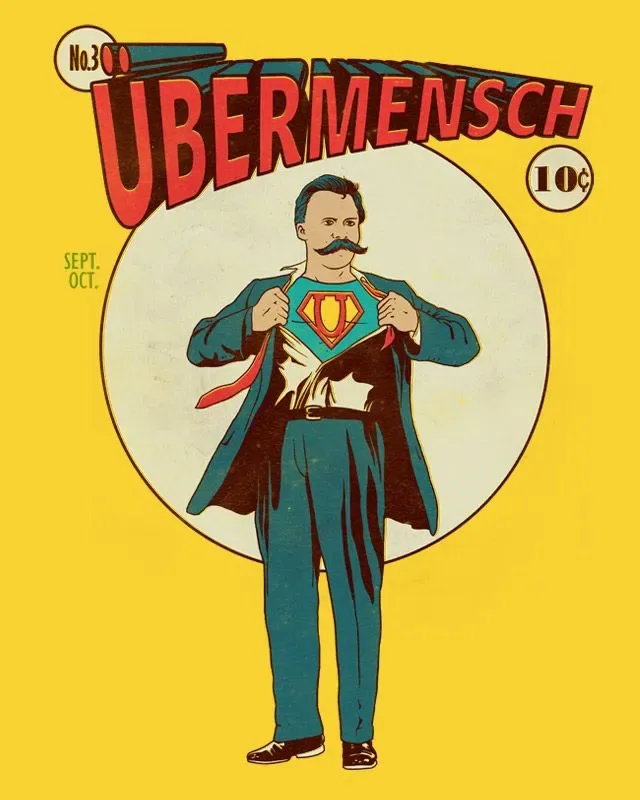
This question sits at the heart of one of Friedrich Nietzsche’s most famous ideas: the Übermensch, often translated as the Overman.
And no, Nietzsche was not talking about Superman flying through the sky.
He was talking about something much more human.
The Person You Could Become
From childhood, we are given instructions about how life should work.
Go to school. Get a job. Be successful. Fit in. Don't disappoint people.
There is nothing necessarily wrong with these things. But Nietzsche wanted people to ask a deeper question:
“Who decided that this is the life I should live?”
We often inherit our values without examining them. We accept ideas because our families, society, or culture accepted them before us.
Nietzsche believed that a person should eventually have the courage to examine these values and decide what kind of person they want to become.
That is where the Overman comes in.
The Overman is not someone who is simply better than everyone else.
It is someone who is constantly overcoming himself.
His fears. His weaknesses. His limitations. His old ways of thinking.
Yesterday's version of himself is not the final version.
The Camel, The Lion, and The Child
Nietzsche tells a fascinating story about three transformations: the camel, the lion, and the child.
The camel carries the burdens placed upon it.
It represents the person who simply accepts what society tells them to carry.
Then comes the lion.
The lion says “No.”
It challenges the old expectations. It refuses to simply live according to the rules it inherited.
But Nietzsche doesn't stop there.
Because constantly saying no isn't enough.
The final transformation is the child.
The child represents creation.
Instead of simply carrying the old values or fighting against them, the child has the freedom to create something new.
And this is where the idea becomes interesting.
It is not enough to say:
“I don't want to live like everyone else.”
You eventually have to ask:
“Then how do I want to live?”
The Real Battle
Maybe the biggest battle is not against society.
Maybe it is against the version of yourself that has become comfortable.
The version that keeps saying:
“I'll start tomorrow.”
“I can't do that.”
“People will laugh at me.”
“This is just who I am.”
Nietzsche challenges that mindset.
You may not be able to control everything that happens to you, but you can continually work on who you are becoming.
You can become more disciplined.
More courageous.
More creative.
More intentional.
Not because you want to prove that you are better than everyone else.
But because you refuse to believe that your current self is the end of your story.
Becoming, Not Arriving
Perhaps this is the most interesting part of Nietzsche's Overman.
It isn't really about arriving somewhere.
It is about becoming.
You overcome one limitation, then discover another.
You learn something, grow, and realise there is still more to learn.
You fail, adjust, and continue.
The goal isn't to become a perfect human being.
It is to refuse to remain exactly who you were yesterday simply because change is uncomfortable.
So maybe the question Nietzsche leaves us with is surprisingly simple:
Are you becoming the person you have the potential to become, or have you simply become comfortable with who you are?
That is the challenge of the Overman.
Not to become greater than everyone else.
But to continually become greater than the person you used to be.


More from Obrempong
Blog
Why Learn Python?
Popular Posts

Blog
5 Things Every Student Must Know About Goals That Actually Work Every Semester

Blog
The Ghana Engineering Students Association GESA KNUST

Blog
From General Arts to Engineering Valedictorian: Finding Balance, Purpose, and Excellence

Blog
Four Time Management Tools Every Student Needs to Master

Blog